Welcome to AI Foundations Course
This comprehensive course explores the key concepts needed to build production-grade AI applications. Through a combination of theoretical foundations and practical applications, you'll build the skills necessary to understand and create AI-powered solutions.
Course Objectives
Ensure all team members—scientists, data engineers, and software engineers—have a strong, common understanding of modern AI/LLM concepts, terminology, and best practices.
Why? This enables more effective collaboration, clearer communication, and faster consensus when designing, reviewing, or iterating on AI architectures.
Equip the team with the knowledge and practical skills needed to design, build, and deploy AI-powered applications that directly address business needs.
Why? This bridges the gap between technical capability and business value, ensuring our solutions are relevant and impactful.
Develop the ability to accurately estimate timelines, resource needs, and technical risks for AI projects. Empower team members to communicate requirements, dependencies, and trade-offs clearly to product managers and stakeholders.
Why? This leads to more predictable delivery, better alignment with business priorities, and fewer surprises during execution.
Integrate and adopt AI-powered coding tools (e.g., AmazonQ, Cline, Cursor etc.) into daily workflows to boost productivity and code quality.
Why? Leveraging these tools allows us to focus on higher-level design and problem-solving, while reducing manual effort and boilerplate.
Encourage team members to experiment with new prompting techniques, architectures, and evaluation methods. Share learnings and best practices across the team to continuously raise the bar for AI application quality and innovation.
Why? The AI field is evolving rapidly; a culture of curiosity and sharing ensures we stay ahead and adapt quickly.
Understanding Generative AI
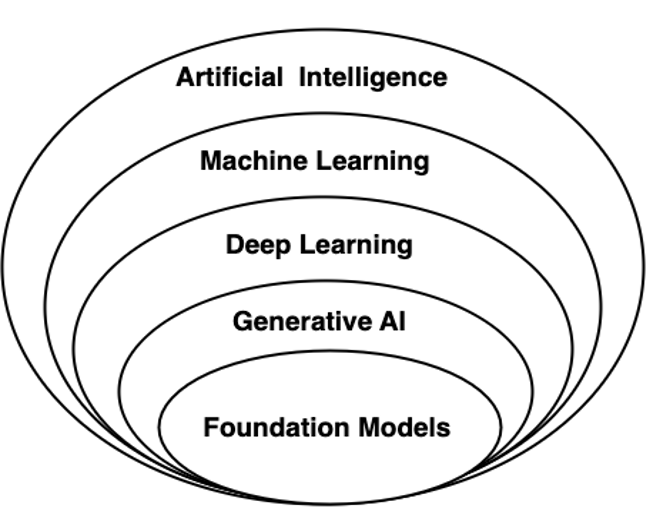
Generative AI represents the cutting edge of artificial intelligence technology, enabling machines to generate, create, and manipulate diverse types of content - from text and code to images, audio, and video.
At its core, generative AI systems can produce new, original content rather than simply analyzing or classifying existing data. This revolutionary capability is transforming how we interact with technology and opening up new possibilities across industries.
Key Components of Generative AI:
Foundation Models
Foundation models are large-scale, general-purpose AI models trained on vast and diverse datasets. These models develop a deep, flexible understanding of language, vision, reasoning, and other domains, serving as the backbone for various specialized applications.
Large Language Models (LLMs)
LLMs like ChatGPT, Claude, Google's Gemini and Amazon's Nova represent a prominent class of foundation models that excel at natural language tasks. These models can understand and generate human-like text, making them powerful tools for applications ranging from content creation to code generation.
Multimodal Models
The latest generation of foundation models (as of 2025) can process and generate multiple types of data simultaneously - understanding images, text, audio, and video in an integrated way. This multimodal capability enables more natural and comprehensive AI applications.
Adapting Foundation Models
While foundation models provide powerful general-purpose capabilities, they typically need adaptation for specific applications. The two primary techniques for customizing these models are:
- Prompt Engineering: The art of crafting text instructions to guide the model toward desired outputs. For most use cases, prompt engineering is faster, cheaper, and more transparent than fine-tuning. Always start with prompt engineering to achieve your desired results.
- Fine-Tuning: The process of retraining models on domain-specific data to specialize them for particular tasks or industries. Only consider fine-tuning if prompt engineering cannot achieve your success criteria, or if you need to adapt the model to highly specialized data. (Note: Fine-tuning is outside the scope of this introductory course but is mentioned for completeness.)
LLM Application Development Approaches
Once you have an adapted model, there are three primary approaches for building applications. All three approaches require effective, well-crafted prompts and can leverage either foundational or fine-tuned models as their reasoning engine:
- Single-Step LLM Applications: The LLM is used in a single, atomic step to complete a task (e.g., summarization, classification, translation). The application logic is simple, and the LLM is called once per user request. With advanced reasoning models, the LLM may use its own internal workflow and control flow to break down complex tasks, but this happens transparently within the single call.
- Workflow-Based LLM Applications: The application consists of multiple, code-defined steps, each of which may involve an LLM call or tool use. The sequence of steps is predetermined and controlled by the developer, not the LLM. Examples include retrieval-augmented generation (RAG), multi-stage data processing, or document extraction pipelines.
- Agentic LLM Applications: A software system that wraps around the LLM, operating in a loop—observing its environment, using the LLM's reasoning to decide what to do next, and taking actions to achieve its goals. Agentic applications often use workflow-based patterns internally but differ by allowing the LLM to participate in the control flow, making autonomous decisions to achieve objectives.
The Evolution of Artificial Intelligence
AI has evolved through the convergence of algorithmic breakthroughs and advances in computing infrastructure.
Early Artificial Intelligence
Machine Learning Era
Deep Learning Revolution
Generative AI (GenAI)
Multimodal & Democratized AI
Agent-Based Systems & AI Reasoning
Course Structure
This course is designed specifically for scientists, software and data engineers. Through a carefully structured learning path, you'll gain both theoretical knowledge and practical skills needed to build production-grade AI applications.
Part 1: Foundational Concepts
Master the core concepts of modern AI development. Starting from fundamentals, you'll progressively build knowledge of language models, prompt engineering, AI agents, and MCP - essential building blocks for creating AI applications.
Key Outcomes:
- Understand how LLMs get to work
- Master effective prompt writing
- Learn the fundamentals of AI agents
- Understand the what, why, and how of MCP
Introduction to Large Language Models
Learn about the architecture, capabilities, and limitations of Large Language Models. Understand the fundamental concepts behind these powerful AI systems that are driving innovation across industries.
Prompt Engineering Guide
Master the art of effectively communicating with AI models through carefully crafted prompts. Learn strategies and techniques to get the most accurate and useful responses from language models.
Agentic LLM Applications
Discover how agentic LLM applications extend language models with memory, tool use, and iterative decision cycles to autonomously solve complex, multi-step tasks. This module covers how agentic LLM applications go beyond single-step or workflow-based applications to deliver adaptable, goal-driven AI solutions.
Developer's Guide to Model Context Protocol (MCP)
Learn how to use MCP to build robust, maintainable AI applications. Understand the core principles of MCP and how it enables standardized communication between AI models and tools.
Part 2: Building AI Applications
In this part, you'll get hands-on experience with the essential tools and frameworks—both open source and cloud-based—used to build, enhance, and operate modern AI applications. We'll focus on practical workflows, integrating knowledge bases, and managing LLM-powered systems in production. Each module is designed to help you build confidence and practical skills for real-world AI development.
Building LLM Workflows with Orchestration Tools
Learn how to use open source and cloud-based orchestration tools to create LLM-powered workflows and agentic applications. Explore how these tools help you chain together prompts, models, and external tools to solve complex tasks, and how to add guardrails for safer AI behavior.
Integrating Knowledge Bases & Semantic Search
Discover how to enhance LLM applications with retrieval-augmented generation (RAG) by connecting to knowledge bases and semantic search systems. Learn how to use open source and cloud-based tools to build semantic layers and vector databases that ground your AI in reliable information.
LLMOps: Monitoring, Evaluation & Prompt Management
Understand the operational side of LLM applications. Learn how to monitor, evaluate, and manage prompts and models in production using modern LLMOps tools and best practices. Explore techniques for observability, prompt/version management, and responsible AI deployment.
Vibe Code & End-to-End AI Agent
Apply everything you've learned by building a complete, end-to-end AI agent using Vibe Code. This capstone module will guide you through the process of integrating workflows, knowledge bases, and operational best practices into a single, production-ready application.